February 8, 2005

Language stuff


Ma ba3rif
Originally uploaded by Jane Rubio.


So the other day I was talking in Arabic to the maintenance guy in front of my 7th graders. Afterwards one of them said, "Miss, you speak like an Egyptian trying to talk Lebanese."

I studied Arabic for one year at Harvard ten years ago. I learned the formal written language, fusHa, with some Egyptian colloquial. The rationale being that most of the media in the Arab world comes out of Cairo. Then about five years after that, I took private lessons with an Egyptian woman in her home. It was about two times a week off and on for about two years. I would go after a long day of teaching high school, and would generally fall asleep as she talked to me too fast in Arabic. I wasn't understanding, and it was too much for my tired brain.

I always thought she was so mean because she would make this "tsk" noise when I got something wrong. Now that I'm here in Lebanon, I realize this is how people say "No." Apparently, they do the same thing in Greece.

Much of the language is body langugage. Not only do you have "tsk," with the chin pointing up to mean "No." You have a slight head rattle from side to side to signify "What? I didn't get you." That can also be accompanied by a twist of an open hand at around chin level. Then there's the big pout meaning "I don't know." I show both at the same time in this lovely picture. Okay, maybe the Lebanese don't do it as exaggerated as I do here.

To say "I want" and "I need" is the same word. (I think there's a profound spiritual significance to this.) To say "I like" and "I love" is the same word. It's like that in French, too.

There are a million terms of affection--Habibee (my beloved), Albee (my heart), Hayatee (my life), Omree (my age). These are used between lovers, friends, and shop owners and customers. So it doesn't really mean anything, unless you want it to.

And then there's "Haram." For those who have studied Islam, you might recognize Haram as prohibited, the opposite of Halal, permitted, like Kosher in Hebrew. But in Lebanon it means "poor thing," like "Pobrecito" in Spanish. Except they use it a lot more here than in the Americas. It seems that in every conversation there is some object of pity. "Oh, she came down with a horrible flu this weekend. . . Haram." The intonation of the voice goes down with the second syllable, making it sound very sappy. In a way, people come off caring and sensitive when they say it, but then as my Canadian friend says, there always seems to be a Haram situation. So that after a while, it seems people say it even when things are really, really ugly like war or imprisonment or a baby dying, and then Haram comes off as trite and even foolish. (Or maybe that's just us non-Lebanese using it all wrong.)

I say it all the time now.

But my favorite use of "haram" is when I'm the subject of the sentence. "Haram, Jane, she has to go back to her lonely apartment by herself." "Haram, Jane, she has to take the bus into Beirut by herself." I, of course, don't really think of myself as a Haram Situation. But here in Lebanon, doing things by yourself and living by yourself are pitiable conditions. Most especially if you're female.

And then there's Sorry, which is what you say when you bump into someone and to mean "excuse me". Like to get a waiter's attention, "Sorry." I hate feeling like I'm apologizing all the time.

In general it seems that there are about 5 ways to say the same thing. This is one reason that Arabic is really hard to learn. Along with the fact that almost all study materials are in either FusHa or Egyptian. We've found only one dictionary that has a majority of words that are Lebanese and one good website.

Bliss Street by Kris Kenway

It's a novel that came out a little more than a year ago about life in Lebanon. When I first started reading it, it was making me mad. Like the British guy was making Lebanon to be so brutish and freakish and crazy. But then after a while, I was like--Geez, I know about everything that he's talking about. And it really is kind of like this.

Read it. I'd be interested to hear what y'all think.

After posting this, Becky got back to me and said that she couldn't find it on Amazon. But I went to his website, www.kriskenway.com, and found a link to the UK Amazon site, where you can get new and used copies for between 2 and 7 pounds.

Welcome to Lebanon


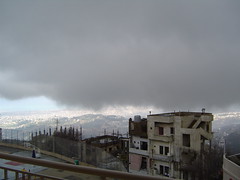
Black clouds pressing on Beirut
Originally uploaded by Jane Rubio.


Probably the most sarcastic phrase ever evented. Whenever something jacked up happens, the people explain it and then end the explanation, with a smile and "Welcome to Lebanon."

For example, when I bought a callback card and the company told me they issued a new one and I'd have to go back to the place where I bought it to exchange it, I went and of course the people there didn't know anything about it. A dude in the store who spoke English, just kind of smiled at my muddling through my attempt to get the right card. He was like "Callback is illegal in Lebanon. You're not going to see your money. . .Welcome to Lebanon."

And then there's the whole no lights/no electricity thing. The lights go out all the time. Nobody flinches. I've learned to carry around a flashlight with me at all times. (Always have wallet, keys, phone, flashlight.) The people here say this is normal. They lived through a war. They always had there flashlights. I just live in a place where the second biggest generator in the country broke because they kept putting off reparing a leaky ceiling. Every other night in Aley at 6 p.m. the power goes out. But that's okay because Aley was a hotzone during the war, and everyone has a generator. . . Welcome to Lebanon.

And then of course is the crazy weather. Snow, clear, sleet, clear, hail, clear. The way you say winter in Arabic is shitty. (It's a similar word for rain, too. Or maybe I'm just confused. . . This happens a lot.) It's a fun English pun. "Winter here is shitty. Welcome to Lebanon."

It's snowing in Aley right now. So I'm stuck in my apartment blogging. I could risk my life and go down to Beirut. But the Damascus Highway is very dangerous even when weather conditions aren't crazy. Dilek is under four feet of snow in Bcharre. The weight of it knocked down a grape orchard and somehow knocked out the electricity. . .Welcome to Lebanon!!

Istanbul


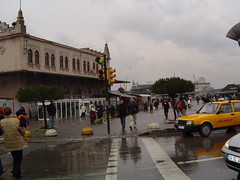
Stoplight in Istanbul
Originally uploaded by Jane Rubio.


Over Eid al-Adha, signifiying the end of the Hajj pilgrimage for Muslims, and the highest religious holiday for the Druze, I went to visit Dilek in Istanbul. She's living with her grandmother on the Asian side. In four days, we did tons of tourist stuff--saw great mosques, the Roman cisterns (totally way cool), and went to a Turkish bath!!! As she was getting scrubbed down, the half-naked Turkish lady told Dilek she was really dirty. I don't know if I was too, because I don't speak Turkish.

As you can see from the pictures www.homepage.mac.com/janerubio/PhotoAlbum24.html, Istanbul is very developed. I chose this picture because it has a street light indicating there are 18 seconds left to cross the street. I realized I hadn't seen one of those in a long time. I don't think there are any traffic signals anywhere in Lebanon. I haven't seen any. And the cars are all new and modern. Not like the 50 year old Mercedes in Lebanon. But there was one shell of a car that I took a picture of.

Before I showed them the pictures, the kids said they thought Turkey would be like Syria--poor and crappy. So they were very surprised to see all the nice, European cars and real bus stops with benches and glass coverings and a map.

I also took pictures of toilets. (You might have noticed this as a running theme in my travel photography.) Considering Turkey is practically Europe in terms of level of development, I was shocked to see an Indian-style toilet on the ferry--grates, water bucket and all. But later on, I saw a very sophisticated toilet with arm rests. . .Wow!

When I showed my students the pictures (we just happened to be studying Turkey in Geography class), they freaked out when they saw me covered in front of the mosque. And then they told me I didn't even do it right because they could see my hair.

Turks eat a lot of simit. It's a sesame pretzel-like bread. They sell it everywhere for the equivalent of about 30 cents. It's way yum. The food in Turkey is cheap and good. We crossed big suspension bridges by foot and dolmosh (a shared van) and took a lot of ferries across the Bosporous.

New Year's in New York


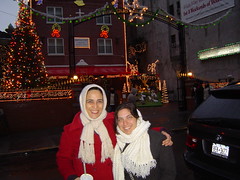
Christine & I in Little Italy
Originally uploaded by Jane Rubio.

New York is cool because there are single people there. I went out to dinner with three other people my age, 28, and we were all single--2 guys and 2 girls. And after dinner, we went to Chris's place and played X-box. That was cool even though I am physically and mentally incapable of playing video games. It's some sort of hand-eye coordination, spatial reasoning malfunction. But after being the only single person among married couples for the past two weeks and finding out that EVERYONE is pregnant, I was happy to be there.

Katy establishments


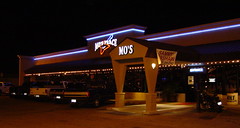
Mo's in Katy
Originally uploaded by Jane Rubio.


Mo's is a bar in Katy. Notice the pick up trucks and motorcycles out front. It is right next to my gym. The people inside all wear cowboy boots and kicker style pants and shirts. They two step on the dance floor.

Mo is short for Muhammad. I think this is funny. Maybe this is a crazy rumor. Would the kickers go somewhere they knew was owned by an A-rab?

It's kind of like how the Kettle, the open 24 hour truck stop that we used to hang out in high school, became a Taqueria Arandas. This is symbolic of my life.

Growing up in Katy, which was predominantly white, I somehow managed to have a bunch of Asian friends. Denise and Linda-Taiwanese; Christie-Vietnamese; Christina-Chinese, Shilpen and Ilyas-Indian, Shari-Iraqi. Somehow these kids were always my friends. But like the whole Mo's thing, I didn't really realize they weren't white like me.

But then I didn't know what I was until I came back from college and started teaching in the "neighborhood." Not Katy, but Southeast Houston. There all the kids were Latino, mostly Mexican. And I was just a source of confusion. "That Miss is Mexican, too." Because I spoke Spanish (not so great) and my dad is Venezuelan/Colombian.

But it was the first time I started to appreciate Mexican food and places like Taqueria Arandas.

For such a hick place, I can find any body, any food, and any language I want in Houston. Even more than in Boston. You just can't get Tex-Mex there.

Hey, Mo's has a website. Troy sent me the link. It's http://www.mosplacekaty.com/index.html. You can see Mo!!

December 28, 2004

Christmas in Aley (a Druze community)


Christmas in Aley
Originally uploaded by Jane Rubio.


So for a Druze community, the Christmas decorations are out in full force. Little white and colored lights everywhere. Santa Clauses on front lawns. The shops in the souk have Christmas trees and garland. Red and green galore.

There were no decorations or lights during Ramadan.

The Druze say they’re not Muslim. Though officially and historically, the religion developed in the 1000's in Fatimad Egypt as an offshoot of an Ismaili Shiite sect. But to me, it seems that many are wanna-be Christian. My Druze students are for the most part very anti-Muslim and have a strong affinity for Christians. One day, a kid yelled out, "Who thinks Christian is better than Muslim?" And the whole 7th grade class raised their hands. This kid also said Christian is better than Druze.

Some Druze go to church. It might be a function of not being able to go to their own house of worship or to know a lot of the substance of their religion, unless they decide to become “religious." (The Druze are a bifurcated society where about 10% choose to become religious. It entails having to dress a certain way and attend certain religious ceremonies.)

Since the Druze religion is philosophically esoteric, Bahai-like, believing in aspects of all religions, many don’t see a problem with going to church or to mosque. Because theirs is the final revelation, all the previous revelations are shadows of the true Druze religion. So officially Druze can participate in other religious services.

However, much of the affinity towards Christianity has to do with social status and class. Christians are at the top; Muslims are on the bottom. The Druze are probably somewhere in between, even though many would claim they're on the bottom. Christian culture is associated with open, modern, Western ways, while Muslims are often associated with Palestinian refugees, Hezbollah, and the all-hated "dirty" Syrians.

Of course, not all the Druze are anti-Muslim. I have plenty of friends who have Muslim friends and Qurans and even go to mosque. But I am often surprised by how positively I am received by this community because I am a Christian. I don't think it would be same were I Muslim.

December 19, 2004

I live in a Druze community—2nd Draft

One of my Druze friends who’s reading my blog thinks that some of the posts are childish (hmmm. . . never been called that before) and many are just straight up offensive.

The sheikh is someone worthy of respect and authority, who regulates conflicts having to do with families and matters of state, not dealing with silly things like the shebab. I’m belittling the community and the religion.

And why am I dissing the Christian guy who wrote it? He's not a bad or ignorant person. In fact, why am I talking like I'm in the academy? That posturing where you always have to diss other people's work, because that's what academics do. Why do I think the sarcasm about studying strange people groups is so funny. I'm just trying to pretend that I belong in the academic crowd, but of course, it's just criticism without substance.

And Lebanon has some of the best hospitals and doctors. You don’t go to the hospital in Lebanon if you want to die. I did do my eye surgery here. And even tested the doctor. When he told me he studied in Houston, I asked him where the best Lebanese food is. “Sami’s.” Check, that’s near where my sister lives, at Hillcroft and Westheimer. Obviously he hadn’t made it out west enough towards Katy to try Phoenicia’s. (That’s so funny. Now I kind of understand the Phoenicia thing. A lot of Christians here refuse to call themselves Arab. Though they speak Arabic, they don’t want to be ethnically linked to Muslims. So they call themselves Phoenician.)

In my attempt to be witty and to make it interesting for you, my readers, I’m mocking and ridiculing Lebanon—a place which I’ve fallen in love with.

I don’t like my pictures of Aley, either. I show so many sheikhs and sheikhas. I don’t show how everyone else is dressed, which is mostly like people in the U.S. and Latin America.

December 5, 2004

Transport: Serveece and Vans


Traffic
Originally uploaded by Jane Rubio.


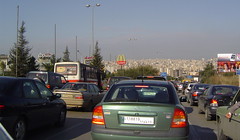
Beirut has a system of shared cabs called service. You stand on the street; the guys slow down; and you tell him the place where you want to go. Half the time, he makes a tsk noise, tilts his head back, and drives off. It seems kind of rude if you're an American, until you learn that this is how Lebanese people say no. If they're heading there, they tilt their head sort of down and towards the door. Sometimes they'll say "Serveecein" which means you pay 2,000 Lebanese Lira, instead of 1,000, which is what service also means. LL 1,000 = U.S. $.67.

So it's a cool idea, and obviously way cheap. But there are a couple problems. It usually takes forever. Not only is traffic in Beirut horrendous, but these guys are always looking for customers, so they slow down whenever they see anyone, and since there can be up to four people in the car, you are often taking detours along the way.

And then half of these guys are major jerks. Like once you're sitting in the car, they'll start renogiating the terms. You looked at him straight in the face and said "Service?" and he nodded down, which means L.L. 1,000, but then he'll start saying that where I want to go is farther or something. Or sometimes they just tell you a different price when you get there. One time a guy drove me literally one minute down a couple side streets, just because I didn't know where the place was, and he charged me 5,000. What the . . .??? I was like No Way, Jose. He was getting aggressive, so I just took out the 1000, dropped it on the seat next to me, and opened the door. But at this point he was grabbing my leg and yelling at me in Arabic. One woman I know was followed out of the car by the chouffer, who then spit on her. So I decided to just give him the 5,000.

But then, of course, they can be nice too. Yesterday a guy took me to a nearby street so that I could take a servicein to Solidaire. He wouldn't take the 1,000 when I gave it to him.

Now the vans are the other way of getting around. I have to take them a lot since I live in Aley. Roller derby is an understatement for the way they drive. I risk my life everytime I get into one, especially since it's on the super windy Damascas highway, going up the mountain. People get concerned for me because they're filled with Syrian workers. (The Syrians are to Lebanese what Mexicans are to U.S. Americans, but the culture here isn't so P.C.) But I've never had a problem, and usually they play good Lebanese pop music. It's just that the driving is way, way crazy. But these are things you get used to when you're not in the U.S.

December 4, 2004

Cell phones in Lebanon


Political cell phone covers
Originally uploaded by Jane Rubio.


Extortion. That's how the Swiss guy in Frankfurt described the cell phone system in Lebanon once I broke it down for him. In this country, there are two cell phone companies which are pretty much the same. People buy cards consisting of a certain number of units for a certain amount of time. A 30 day card that gives you about 150 speaking minutes costs about $50. That is a HUGE amount of money for the people here, considering average salaries might be $400 a month. So if you don't recharge your card by the 30th day, you lose your units. When you use up your units or after the 30 days, they give you 5 days where you can just receive calls, but if you don't recharge before those days are up, you lose your line. Which means you have to spend around $70 for a new phone number.

It's a horribly ridiculous system. There is no competition. Apparently it's all run by the mob. The people of Lebanon went on strike last summer, abstaining from using the cell phone on Mondays. But that did nothing.

Even landline usage is super expensive. And there's no voicemail because that would take someone's units. People SMS a lot. And there's developed a mode of communication called the missed call. People decide what the missed call is going to mean beforehand, like I'll give you a missed call when I get there. This is kind of stressful. You have to really think about if you're going to pick up the phone when someone calls because you don't want to take up their units.

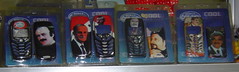
And check out the cool cell phone covers. From left to right, there's Walid Jumblatt, the head of a Druze political party, son of Kamal Jumblatt, who was killed during the Civil War. Hafez Al Assad, the late president of Syria. Mousa Al Sadr, a Lebanese Shiite leader who disappeared visiting Lybia in the 70's. And last but not least, Rafik Al Hariri, the Lebanese Prime Minister who recently stepped down. Hariri's company, Solidaire, has been responsible for rebuilding Beirut since the end of the Civil War.

Since most of the Druze and Christian Lebanese people I know can't stand Syria, I don't know who would go around with Hafez Al Assad on her phone. If I went around with Al Sadr on my phone, I'd be considered some sort of radical Shia sympathizer. It would be like going around with Che Guevara stuff, which is very popular here also. But if I go with Walid Jumblatt, that would gain me a lot of brownie points, since I live in a Druze community.